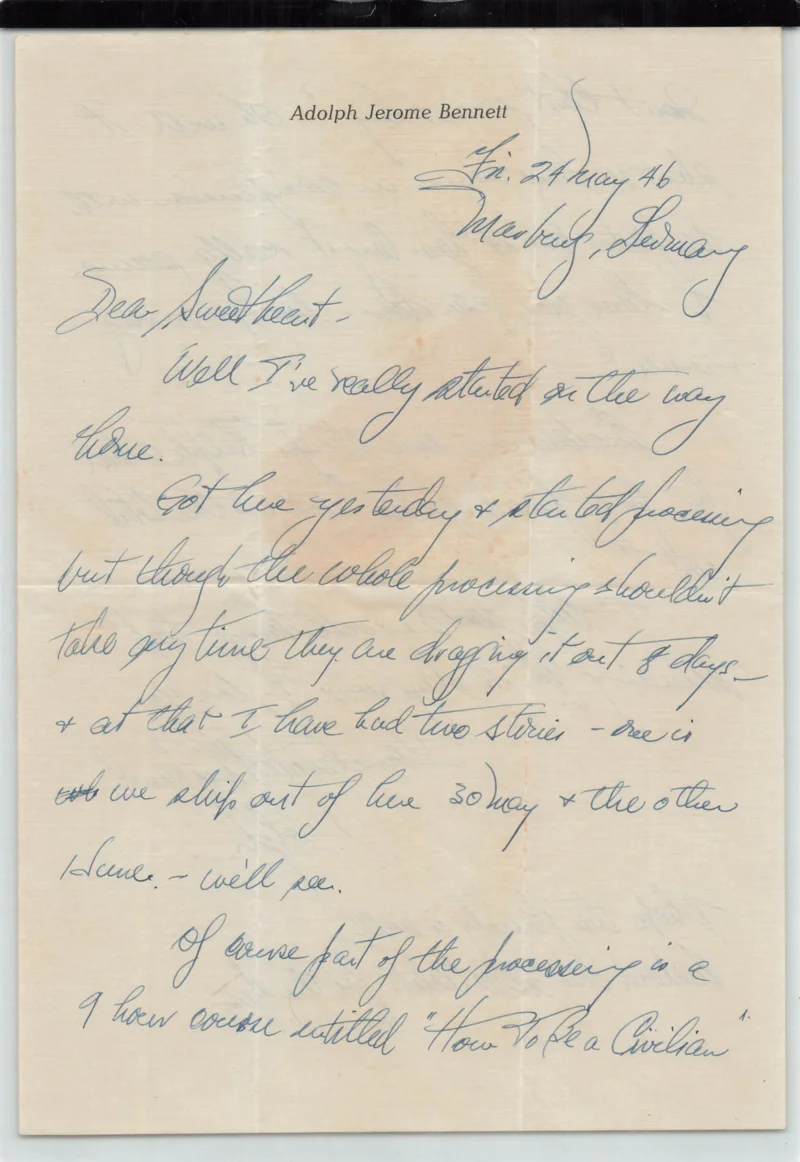
Marburg, Germany
Adolph Jerome Bennett stationery
Dear Sweetheart,
Well I've really started on the way home.
Got here yesterday & started processing but though the whole processing shouldn't take any time they are dragging it out 8 days – & at that I have had two stories – one is we we ship out of here 30 May & the other 1 June. – we'll see.
Of course part of the processing is a 9 hour course entitled "How To Be a Civilian"
[Page 2]
Isn't that something? Oh well – it shant be long now – in comparison with the past – but oh how long it really seems.
I love you Jean dear – love you so very much.
Enclosed are some stamps Ralph asked for, for a friend of his. $3.50 is the total cost.
I hope you are well honey, keep smiling for it's days now. I love you.
Your devoted husband,
Dolph
I hope the family is well.
Enclosed are also tickets for the Opera.
# Contextual Notes for Letters 141-146
# Notes & Context
The Story Arc
A Love Story in Wartime
Dolph and Jean Bennett were married on March 26, 1944, just months before D-Day. By January 1945, both were serving their country — Jean as a Navy WAVES officer in Atlanta, Dolph as an infantry lieutenant preparing to ship overseas. What follows in these letters is the story of their separation, Dolph's survival of combat, and their long struggle to reunite.
The letters reveal a deeply romantic man who wrote to his wife nearly every day, often multiple times. His devotion is constant: "I love you — always + all ways" appears in virtually every letter. He dreams constantly of their postwar life together — a cottage in the country, trips to Europe, children. He saves a can of tomato juice to toast their anniversary. He sends gifts arranged months in advance.
But the letters also capture the reality of war: the poverty of French civilians, the fear of combat, the randomness of death and survival. When Dolph is wounded on March 17, 1945, he immediately writes to reassure Jean it's just a "scratch" — though it was serious enough to send him to a convalescent hospital for over a week.
The Wound
On St. Patrick's Day 1945, Dolph was wounded near Wadern, Germany. A shell fragment struck the underside of his left forearm. In his letter that day (Letter 40), he downplays the injury:
> "I received a scratch, believe me, in the underside of my left forearm. It's so slight I thought I could get it dressed at the aid station..."
But the wound was more serious than he let on. He spent over a week in a convalescent hospital in France, and later wrote about how his survival story was remarkable among the "bull sessions about how we got hit." He credits Jean's prayers and God's protection throughout.
V-E Day
Letter 87, dated May 8, 1945, captures V-E Day as Dolph experienced it:
> "This has been a banner day. Not only has Churchill announced that hostilities are officially over as of one minute past midnight; but I heard from you!"
The same day the war in Europe ended, Dolph finally received mail from Jean — a package postmarked February 15, nearly three months earlier. The juxtaposition is striking: world-historical events and the simple joy of hearing from his wife, both arriving on the same day.
His description of V-E Day in Germany is notably subdued: "It's very quiet here. No noise, no nothing, but the war is over + that's what counts."
The Holocaust Witness
Perhaps the most historically significant letters come from the occupation period. In Letter 131 (February 7, 1946), Dolph recounts what his friend Henry Cohen, an UNRRA director at a Jewish Displaced Persons camp, told him:
> "Out of a prewar population outside of Russia there were 6 million Jews, now there are less than 200,000."
The statistics are imprecise but the horror is clear. Cohen described conditions at the Wolfratshausen camp: survivors so demoralized they had forgotten basic sanitation, who fled when trucks came (fearing transport to death), who dealt on the black market simply to survive, whose only hope was Palestine.
Even more powerful is Letter 139 (April 24, 1946), where Dolph attended a memorial service at a DP camp:
> "Never in my whole life have I heard anything to compare with what happened... the ensuing wailing, the crying that went on I shall never forget. These were the remnants of the thousands of upon thousands of Jews who perished under Hitler and they couldn't help but mourn the loss of their close ones who died so tragically and painfully. It was the whimpering of hurt animals, of Mothers and Fathers who see the scene of their children being torn away and butchered."
And then, the personal connection:
> "But for the grace of God I and my beloved ones might have been in the very same position, and my heart went out to them."
Dolph was Jewish. These were his people.
Hitler's Bunker
Letter 143 (April 22, 1946) contains a remarkable account of Dolph's visit to Hitler's bunker, exactly one year after Hitler's suicide. He toured the destroyed Reich Chancellery and, by "lucky break," gained access to the underground shelter:
> "I was in the actual room where his body was found... I couldn't help but feel a little smug and quite satisfied that I was able to be alive in the exact place where the death of the anti-Jew took place."
The letter also contains vivid observations of post-war Berlin — the "cigarette butt situation" where desperate Germans would practically take cigarettes from his hand, the contrast between awkward Russians in "coarse" clothing and the "elegant society" of the occupation, the blocks of destroyed buildings.
Coming Home
The final letters document Dolph's bureaucratic struggle to either civilianize (take a civilian job in the occupation government) or simply come home. By May 1946, after months of frustration, he secures a CAF-11 position at $5,700/year but ultimately chooses to return to Jean.
The last letter (146, May 24, 1946) finds Dolph at Marburg, taking a 9-hour course called "How To Be a Civilian" — a fitting end to 16 months of wartime correspondence.
Historical Context
The Final Months of the European War
When Dolph shipped overseas in February 1945, the war in Europe was in its final phase but far from over. The Battle of the Bulge had just ended (January 25, 1945), and Allied forces were preparing for the final push into Germany.
Key military events during Dolph's combat period:
- February 4-11: Yalta Conference (Roosevelt, Churchill, Stalin)
- March 7: Remagen Bridge captured — first Allied crossing of the Rhine
- March 17: Dolph wounded near Wadern, Germany
- March 22-23: Allied forces cross Rhine in force
- April 12: President Roosevelt dies; Truman becomes president
- April 25: American and Soviet forces meet at Elbe River
- April 28: Mussolini executed by Italian partisans
- April 30: Hitler commits suicide in Berlin bunker
- May 2: Berlin falls to Soviet forces
- May 7: Germany surrenders unconditionally at Reims
- May 8: V-E Day — Victory in Europe
The 10th Armored Division
Dolph served with the 61st Armored Infantry Battalion, part of the 10th Armored Division, nicknamed the "Tiger Division." The 10th Armored had been heavily engaged in the Battle of the Bulge, where it helped hold Bastogne. By March 1945, it was pushing deep into Germany as part of Patton's Third Army.
The division's route took it through the Saar region, across the Rhine, and into Bavaria. Dolph joined as a replacement officer just as the final offensive began.
The Occupation
After V-E Day, American forces transitioned from combat to occupation duties. Dolph worked with the Office of Military Government, United States (OMGUS), the organization responsible for governing the American zone of occupied Germany.
Key aspects of the occupation included:
- Denazification: Removing former Nazis from positions of power
- Displaced Persons: Managing millions of refugees, POWs, and concentration camp survivors
- Economic reconstruction: Preventing starvation while rebuilding German industry
- War crimes trials: The Nuremberg Trials began November 20, 1945
The Holocaust and Displaced Persons
By 1945-46, the full horror of the Holocaust was becoming clear. Dolph's letters provide eyewitness accounts of the aftermath through his descriptions of DP camps.
The Jewish DP camps housed survivors of concentration camps, death marches, and hiding. Most had lost their entire families. Many were stateless — unable or unwilling to return to countries where they had been persecuted. The vast majority hoped to emigrate to Palestine (then under British mandate), but British restrictions on immigration created a humanitarian crisis.
Henry Cohen's statistics in Letter 131 — "6 million Jews... now there are less than 200,000" — refers to the Jewish population of Europe outside the Soviet Union. While the exact figures were still being determined in early 1946, this captures the scale of destruction.
People Index
The Bennett Family
| Name | Relationship | Notes |
|------|--------------|-------|
| Adolph J. "Dolph" Bennett | Letter writer | Lt., Infantry; born April 20, 1919; wounded March 17, 1945 |
| Jean Bennett | Wife | Ensign, Navy WAVES; stationed Atlanta; author of Letter 111 |
| Mother | Dolph's mother | Lives in New York; frequently mentioned |
| Monty | Dolph's brother | Mentioned in early letters |
| Ralph | Possible brother | Mentioned in Letter 1 (toilet incident) |
| Marion | Relative | To receive photos |
The Carton Family (Jean's Family)
| Name | Relationship | Notes |
|------|--------------|-------|
| Dad Carton | Jean's father | Visited Atlanta Oct 1945; lobbied Senator Russell |
| Fan/Fanny Carton | Jean's mother | Died January 1946 |
| Marion | Jean's sister | Frequently mentioned |
Military Personnel
| Name | Role | Notes |
|------|------|-------|
| Gen. George Patton | Commander, 3rd Army | Dolph served under his command |
| Gen. Lucius Clay | Military Governor | Spoke at DP memorial; involved in civilianization |
| Ambassador Robert Murphy | Diplomat | Spoke at DP memorial service |
| Gen. McNarney | Commander, USFET | Attended Passover seder 1946 |
| Lt. Col. Harrington | Senior officer | Helped Dolph get socks (Letter 9) |
Friends and Acquaintances
| Name | Context | Notes |
|------|---------|-------|
| Henry Cohen | UNRRA director | 23, City College/MIT, Phi Beta Kappa; ran Wolfratshausen DP camp |
| Bob & Robbie | Berlin friends | Bob taught English at Lincoln HS; Robbie was political reporter |
| Paul | Fellow officer | In France and later Berlin |
| Fred | Fellow officer | Discussed marriage with Dolph |
| Ethel | Friend | Sent care packages |
| Michel | French girl | 7 years old; in Givet family |
| John Drew Devereaux | Fellow officer | Connected to Barrymore family |
| Nikolai | Russian pilot | Buchenwald survivor |
Historical Figures Mentioned
| Name | Context |
|------|---------|
| President Roosevelt | Death reported April 12, 1945 (Letter 65) |
| President Truman | Succession noted |
| Hitler | Death reported; bunker visited |
| Mussolini | Execution reported |
| Goebbels | Death reported |
| Admiral Doenitz | Succeeded Hitler |
| Heinrich Himmler | Surrender attempts discussed |
| Hermann Goering | Air ministry noted as undamaged |
| Jesse Owens | 1936 Olympics referenced during Berlin tour |
| Roscoe Ates | USO comedian; performed at convalescent hospital |
Places Index
United States
- Fort George G. Meade, MD — A.G.F. Replacement Depot #1 - Hartford, CT — First letter written on train here - Atlanta, GA — Jean's duty station; 619 Peachtree St. N.E. - New York City — Family home; 624 W. 182nd St.United Kingdom
- Scotland — First landfall in Europe; "Grimm's Fairy Tales alive" - England — Transit; detailed observations of trains, bicycles, cultureFrance
- Le Havre — Devastated port city; first French landfall - Givet — Town near Belgian border; evening with French family - Convalescent Hospital — March 19-27, 1945 recovery location - Replacement Depot — Various locations April-June 1945Germany
- Wadern — Near location where Dolph was wounded - Frankfurt — Primary base during occupation; OMGUS headquarters - Berlin — Visited April 1946; Hitler bunker, Staatsoper, DP camp - Nuremberg — War crimes trials; British POW friends testified - Marburg — Processing center; final letters - Wolfratshausen — UNRRA DP camp run by Henry CohenOther
- Luxembourg, Belgium — Transited through - Maginot Line — Dolph quartered in fortificationsMilitary Glossary
| Term | Definition |
|------|------------|
| A.G.F. | Army Ground Forces |
| APO | Army Post Office |
| C-47 | Military transport aircraft |
| CAF | Civilian Administrative Function (job classification) |
| DP | Displaced Person |
| OD | Olive Drab (uniform color) |
| OMGUS | Office of Military Government, United States |
| PX | Post Exchange (military store) |
| UNRRA | United Nations Relief and Rehabilitation Administration |
| USFET | United States Forces, European Theater |
| V-Mail | Victory Mail (microfilmed letters for faster delivery) |
| WAVES | Women Accepted for Volunteer Emergency Service (Navy) |
| "40 or 8" | French boxcars marked "40 hommes ou 8 chevaux" |
Recurring Themes
Love and Devotion
Nearly every letter closes with "Your devoted husband" and variations of "I love you." Dolph's devotion is expressed through: - Daily letters, often multiple per day - Dreams of postwar life together - Planning gifts months in advance - Saving tomato juice to toast their anniversary - Constant reassurance of faithfulnessFaith and Providence
Dolph frequently credits God and Jean's prayers for his survival: - "The good Lord is paying attention to your prayers" - "My story stands up as a testimony to God" - "But for the grace of God I and my beloved ones might have been in the very same position"Cultural Life
Even in wartime, Dolph sought out cultural experiences: - Movies nearly every night when available - Opera in Berlin (Tales of Hoffman, Rigoletto) - Ballet at the Staatsoper - Piano concerts (Chopin, Debussy) - Quotes Shelley and Housman in lettersDreams of Home
Constant planning for postwar life: - Country cottage with acreage - Apartment in the city for work - Home design with removable wall panels - "A month in bed!" - Children togetherJewish Identity
Dolph's Jewish identity appears throughout: - Attends services when possible - Grateful for interfaith chaplains - Deeply moved by DP camp memorial - Personal connection to Holocaust: "I and my beloved ones might have been..." - Satisfaction at being "alive in the exact place where the death of the anti-Jew took place"Notable Quotes
On Love
> "Our love is steadfast & true & no matter how long our separation may be I am yours completely & wholly & there can never be another like you." (Letter 1)> "I have found a little pixie in you — I like it." (Letter 1)
> "A month in bed!" (Letter 15)
> "I love you — always + all ways, + tho I close this letter I never close my heart." (Letter 48)
On War
> "Everyone asks — Why don't they give up? The only answer I can arrive at, is that the Nazis are in complete control + they personally have everything to lose." (Letter 39)> "I received a scratch, believe me, in the underside of my left forearm." (Letter 40)
> "This has been a banner day. Not only has Churchill announced that hostilities are officially over as of one minute past midnight; but I heard from you!" (Letter 87, V-E Day)
On the Holocaust
> "Out of a prewar population outside of Russia there were 6 million Jews, now there are less than 200,000." (Letter 131)> "It was the whimpering of hurt animals, of Mothers and Fathers who see the scene of their children being torn away and butchered." (Letter 139)
> "But for the grace of God I and my beloved ones might have been in the very same position, and my heart went out to them." (Letter 139)
On History
> "I was in the actual room where his body was found... I couldn't help but feel a little smug and quite satisfied that I was able to be alive in the exact place where the death of the anti-Jew took place." (Letter 143, Hitler's bunker)> "Scotland is Grimm's Fairy Tales alive." (Letter 19)
Literary and Cultural References
Books and Poetry
- Shelley — Quoted in Letter 43: "I love Love — though he has wings / And like light can flee..." - A.E. Housman — "Be still, my soul, be still" quoted in Letter 44 - "How Green Was My Valley" — Referenced describing Scotland (Letter 19) - "My Dreams" — Poem by Cpl. William S. Hood Sr. enclosed with Letter 46Films Mentioned
- Bride by Mistake - Animal Kingdom (Letter 82) - Objective Burma (Letter 90) - When Strangers Marry - Mark of the WhistlerOpera and Ballet
- Tales of Hoffman (Offenbach) — Berlin, newly revived; banned under Hitler because Offenbach was Jewish - Rigoletto (Verdi) — Berlin - Othello (Verdi) — Planned but changed to ballet - Don Juan (Gluck) — Ballet, Berlin Staatsoper - Daphnis and Chloe (Ravel) — Ballet - Bolero (Ravel) — BalletAbout the Transcription Project
These letters were transcribed from original handwritten documents by Zach Bennett (Dolph and Jean's grandson) with AI assistance in 2025, approximately 80 years after they were written.
The transcription preserves Dolph's original spelling, grammar, and punctuation, including his characteristic use of "+" for "and." Editorial insertions are marked with brackets. Illegible passages are noted.
The collection represents an invaluable primary source for:
- World War II military history
- The American experience in the European Theater
- Post-war occupation of Germany
- Holocaust survivor displacement
- Social history of wartime marriage